
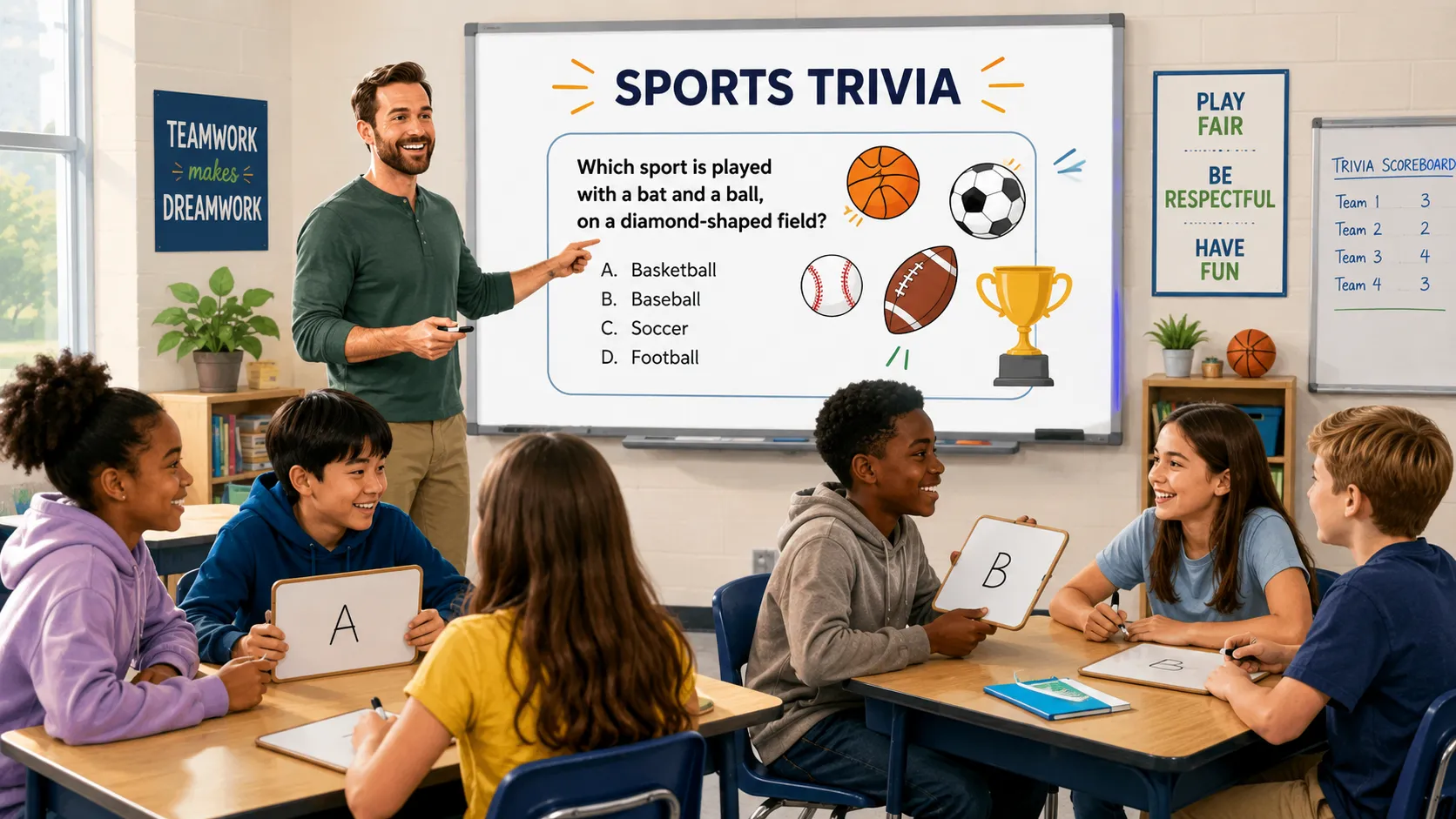
How to Use Sports Trivia Questions in the Classroom
Sports trivia can serve several different purposes in the classroom. A few questions can open a lesson, provide a brief change of activity, support a review session, or give students a structured reason to work together.
The useful part is not simply asking more questions. Teachers get more from trivia when the format fits the moment, the difficulty suits the students, and the questions have a clear purpose. That can mean a three-question bell ringer on one day and a longer team activity on another.
Start With What You Want the Trivia to Do
Choose the purpose before choosing the questions. A warm-up, review game, brain break, and collaborative activity may all use sports trivia, but they need different amounts of time and preparation.
At the beginning of class, a few questions can give students something specific to work on while everyone settles in. They might answer individually first and then compare responses with a partner before the class checks the answers.
Trivia can also support review when the questions connect naturally to material students have already encountered. In that situation, the important part is what students are being asked to recall, explain, compare, or apply. The sports theme should support that goal rather than replace it.
Other uses can be deliberately lighter. A quick round between longer activities can provide a brief change of activity. Trivia can also work as an icebreaker, an occasional end-of-class challenge, or a collaborative activity when the goal is to get students talking with one another.
Knowing the purpose also makes it easier to stop at the right point. A five-minute warm-up does not need the scoring system or structure of a full classroom game.
Choose Sports Questions That Fit the Students
A question can be factually correct and still be a poor classroom choice. Consider students’ age, grade level, familiarity with sports, language background, and the range of interests in the room.
A broad collection of sports trivia questions and answers can provide a starting pool. From there, select questions that students can understand without needing specialized knowledge of one league, era, or statistical category.
For groups with limited sports knowledge, easy sports trivia questions can make the activity easier to enter. Familiar athletes, basic rules, widely recognized teams, and major sporting events generally give more students something to work with than obscure records or detailed historical statistics.
More knowledgeable students can still be challenged. A small number of hard sports trivia questions can work as bonus questions or as part of a harder final round without setting that difficulty level for the entire activity.
Not every question has to test detailed factual recall. Nicknames, recognizable logos, unusual sporting moments, and fun sports trivia questions can change the tone of a round and work especially well for lighter activities.
Variety matters because sports knowledge is rarely distributed evenly across a class. One student may follow basketball closely, another may know soccer, and another may have little interest in organized sports. A broader mix gives students more ways to contribute.
Pick a Classroom Format That Matches the Moment
The same question bank can support several classroom activities. Instead of creating a completely new quiz each time, change how students respond based on the goal and the time available.
Use a Few Questions as a Bell Ringer
Put two or three questions on the board as students arrive. They can answer independently, compare ideas with a partner, or simply write their best guesses before the class reviews them.
This format needs very little setup and does not require formal teams or scoring. If one question connects naturally to the day’s lesson, use the answer as a transition. Otherwise, keep the activity brief and move into the planned work.
Turn Trivia Into a Team Challenge
For a longer activity, place students in small groups and allow each team to submit an answer to every question. This gives more students time to think than a format based entirely on whoever raises a hand first.
A simple option is one point for each correct answer. Teams can respond on paper, mini whiteboards, or another classroom response system. Revealing answers at the same time keeps the process easy to follow.
Use Trivia as a Short Brain Break
A brain-break round does not need elaborate rules or a winner. Ask a handful of accessible questions between longer classroom tasks and keep the activity moving.
Students might vote among possible answers, discuss a question with a neighbor, or answer as a whole class. The purpose is to provide a brief change of activity and then continue with the lesson.
Build a Trivia Review Round
Sports can provide a framework for reviewing academic material when the connection is genuine. A math class might work with scores, percentages, or statistics. Geography might use the locations of competitions or teams. PE may connect questions with rules, terminology, or the history of a sport students are studying.
Avoid forcing a sports connection where it does not help students understand the material. If explaining why the question belongs in the lesson takes longer than answering it, another review format may be clearer.
Let Students Write the Questions
Students can also become question writers. Give them a topic and ask each student or group to create a small number of trivia questions with verified answers.
Writing the question requires them to decide what information is relevant and phrase the prompt clearly enough that another person can answer it. Before using student-created questions with the class, check the wording and the supporting facts.
Strong questions can be saved for later activities and gradually added to a reusable classroom collection.
Get Students Moving With Stations
Place questions at several stations around the classroom and have pairs or small groups move from one to another. Each station can contain a single question, a category, or a short set of related prompts.
Students record their answers as they move and review them afterward. This requires more preparation than a verbal round, but it offers a different classroom structure when you do not want every activity to happen from a seat.
The table below provides a quick way to match the activity to a classroom goal.
| Classroom goal | Simple format | Basic setup |
|---|---|---|
| Start class | Bell ringer | A few questions on the board |
| Review material | Team round | Questions and answer sheets |
| Change the pace | Short trivia break | Brief verbal or visual round |
| Encourage collaboration | Team challenge | Small groups and simple scoring |
| Give students more ownership | Student-written trivia | Topic and fact-check instructions |
The same set of questions can move between several of these formats, which makes it easier to reuse material instead of rebuilding every activity from scratch.
Keep Competition Inclusive and Low Pressure
Competition can add structure and energy, but students should not need extensive sports knowledge just to participate.
Teams are useful because they allow students to combine different kinds of knowledge. One student may recognize an athlete, another may understand the rules of a sport, and someone else may be able to reason through possible answers.
Avoid elimination formats if your goal is broad participation. A student who misses one question should still have a reason to think about the next one.
It can also help to rotate responsibilities within teams. Instead of allowing the most confident sports fan to submit every response, change who records the answer, explains the team’s reasoning, or reports back to the class.
Question selection remains important. A general classroom activity does not need equal representation from every sport, but it should not accidentally become a test of one student’s favorite league. Mixing categories and difficulty levels creates more entry points.
Scoring should support the activity rather than dominate it. If students spend more time arguing over points than discussing the questions, simplify the scoring or reduce its importance.
Use the Answer as the Start of the Learning
Sometimes the correct answer is enough. At other times, a trivia question can open a useful short discussion.
Ask students how they reached an answer. Some may know it immediately, while others may have eliminated alternatives or noticed a clue in the wording. Comparing those approaches gives students a chance to explain their reasoning instead of focusing only on whether the response earned a point.
An unfamiliar answer may also need a little context. If a question mentions a competition, country, athlete, rule, or historical event that students do not recognize, a short explanation can make the question more meaningful.
Where a curriculum connection is natural, follow the answer with another prompt. A geography class might locate a host city. A math class could work with a relevant score or percentage. A PE class might discuss a rule connected to a sport students are learning.
The connection should remain purposeful. There is no need to turn every sports fact into a miniature lecture. Some questions can simply be answered and left behind.
A good signal is student curiosity. If the answer prompts genuine questions about how an event happened, where it took place, or why a rule works a certain way, a short discussion may be more valuable than immediately moving to the next trivia item.
Check the Questions Before Students See Them
Sports content needs fact-checking just like other classroom material. This is especially important for records, active athletes, team affiliations, rankings, championships, and season-specific information that can change over time.
Review the wording separately from the answer. Make sure the question contains enough information to point to one response and does not accidentally allow several equally reasonable interpretations.
Decide how you will handle alternative wording as well. A student’s answer may use an accepted shortened team name or an athlete’s surname rather than the exact wording on the answer key. Thinking about these cases beforehand makes classroom decisions more consistent.
Student-written trivia should go through the same process. Ask students to verify the information they use instead of relying entirely on memory.
Keep a clean answer key for the final activity. If a question turns out to be genuinely ambiguous, acknowledge the problem rather than trying to defend the wording simply because it was prepared in advance.
Avoid Common Classroom Trivia Problems
A quick review before class can prevent most of the problems that make a trivia activity awkward or unnecessarily difficult.
Watch for these issues:
- Questions that are consistently too difficult. Include enough accessible material that students with different levels of sports knowledge can participate.
- One student dominating the game. Use teams, simultaneous written responses, or rotating roles so others have time to contribute.
- Too much emphasis on one sport. Check the final mix unless the activity is intentionally built around a single theme.
- Complicated scoring. Keep the system simple enough that calculating points does not consume the activity.
- Outdated answers. Recheck changing records, affiliations, rankings, and recent results.
- No clear classroom purpose. Know whether the trivia is being used as a warm-up, review, brief break, or collaborative activity.
- Students being excluded by prior sports knowledge. Mix difficulty levels and use formats that allow teamwork and reasoning.
- Every answer becoming a long explanation. Expand only when the discussion supports the purpose of the activity.
Stop the activity once it has served its classroom purpose rather than extending it simply because more questions are available.
Make Sports Trivia Easy to Reuse
You do not need a new game every time you bring sports trivia into the classroom. Keep verified questions organized by topic, difficulty, and the types of activities where they worked well.
A question used in a team challenge one week might become a bell ringer later. Student-created questions can be added after they have been checked, while confusing or outdated questions can be removed.
Over time, that gives you a flexible collection that can support short warm-ups, review activities, team challenges, and occasional classroom breaks without turning every use of trivia into a full-scale event.
FAQ
How can teachers use sports trivia in the classroom?
Teachers can use sports trivia as a bell ringer, review activity, team challenge, short brain break, or student-created question activity. The best format depends on the lesson goal and the time available.
How do I choose sports trivia questions for students?
Choose questions that fit the students’ age, sports knowledge, and interests. Mix easier and more challenging questions, avoid relying too heavily on one sport, and check that every question has a clear, accurate answer.
Can sports trivia be used as a classroom review activity?
Yes. Sports trivia can support review when the questions connect naturally to material students have already studied. The sports theme should help students recall, discuss, or apply the lesson content rather than distract from it.
How can I include students who do not know much about sports?
Use team formats, broad categories, mixed difficulty levels, and questions that do not depend entirely on detailed sports knowledge. Avoid elimination games so students can continue participating after an incorrect answer.
Should students create their own sports trivia questions?
They can. Student-created trivia gives learners a chance to select information, write clear questions, and verify their answers. Teachers should review the questions for accuracy and clarity before using them with the class.